1. Read the question
A fictional workshop has a service policy, an inspection schedule and a maintenance report. The question is: what needs attention before the next inspection?
Project case study · Document Intelligence
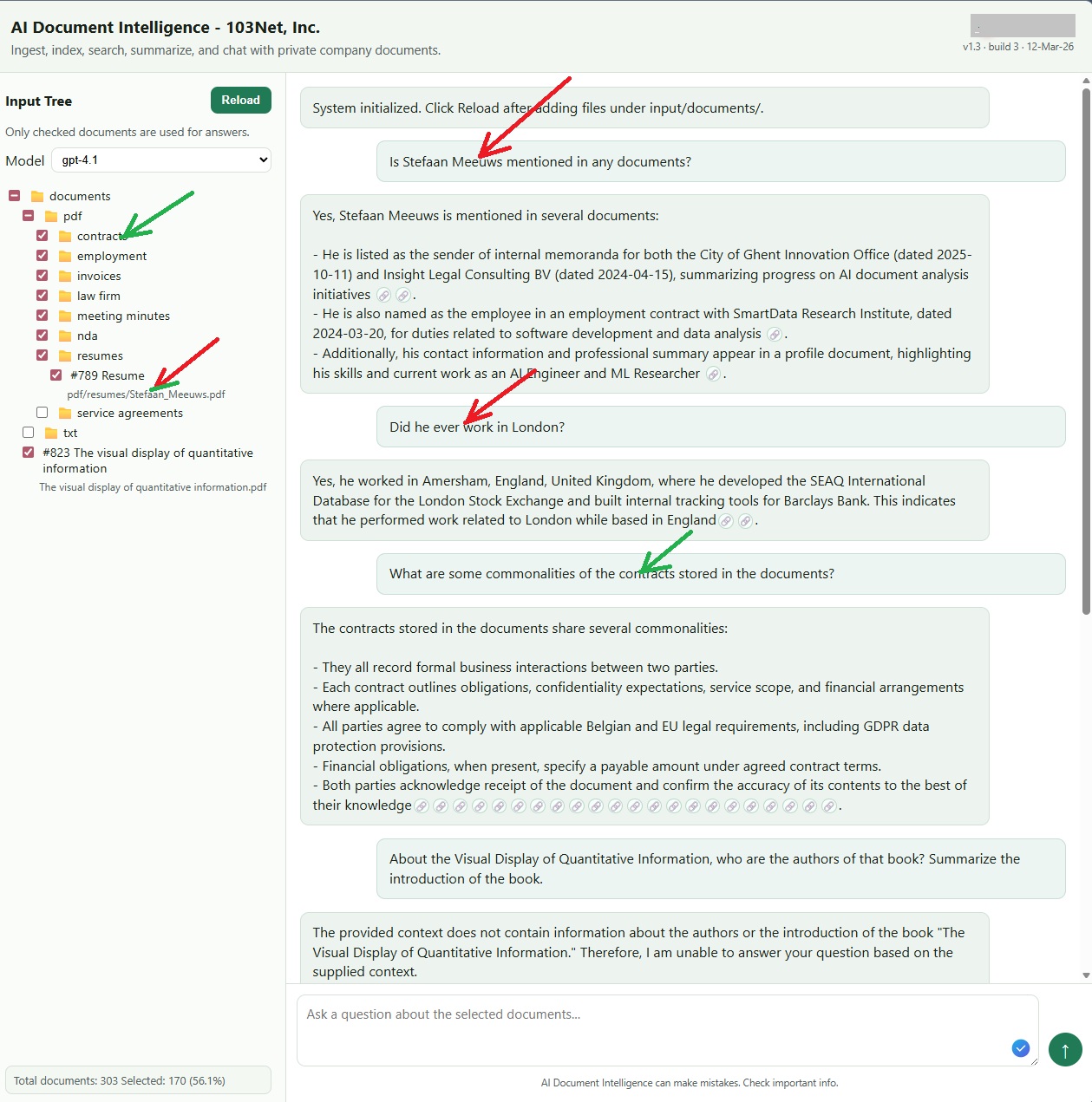
A Python document application built by Stefaan Meeuws to search document collections, summarize selected files and answer questions with source references.
Portfolio application and demonstration. The public walkthrough uses fictional documents and prepared answers.
The problem
When policies, schedules and reports live in separate documents, finding an answer can mean opening several files and comparing passages manually.
The application explores a more direct workflow: select the documents that matter, ask a question and inspect the supporting sources. The goal is to make the answer easier to find and check.
A concrete example
A fictional workshop has a service policy, an inspection schedule and a maintenance report. The question is: what needs attention before the next inspection?
The prepared walkthrough points to a replacement battery for an emergency light, and to confirming access before the inspection.
The maintenance report records the battery issue. The inspection schedule explains who must confirm access. Readers can open both original passages.
This example explains the workflow. It does not run a live AI model or search your own documents.
Open the example and inspect its sources →What this demonstrates
The project demonstrates document ingestion, retrieval and a question-answering interface with source references. A live demonstration can show the working application's behavior on sample documents.
The public examples do not establish accuracy across every document collection or measured time savings for a client. Generated answers and their sources still need review.
For a client project, we would agree a representative set of questions and expected answers, check retrieval and source relevance, and measure the workflow against the current process before deciding on a wider rollout.
Planning a client system
The demonstration application stores documents, its index and indexing records on the machine where it runs. When OpenAI answers are enabled, it sends the question and retrieved excerpts to OpenAI. Without an OpenAI API key, it returns extracted passages with source references.
Hosting, authentication, user permissions, approved data sources, permitted external services, storage, backups and retention. Selecting documents controls search scope; access permissions for a shared system must be implemented as part of that deployment.
A focused collection of approved sample documents, agreed questions and success criteria, a working first version and a review of the results. The scope and price depend on those requirements.
Explore your document workflow
We can discuss the documents, users and requirements, then decide whether a focused prototype is a useful next step.